
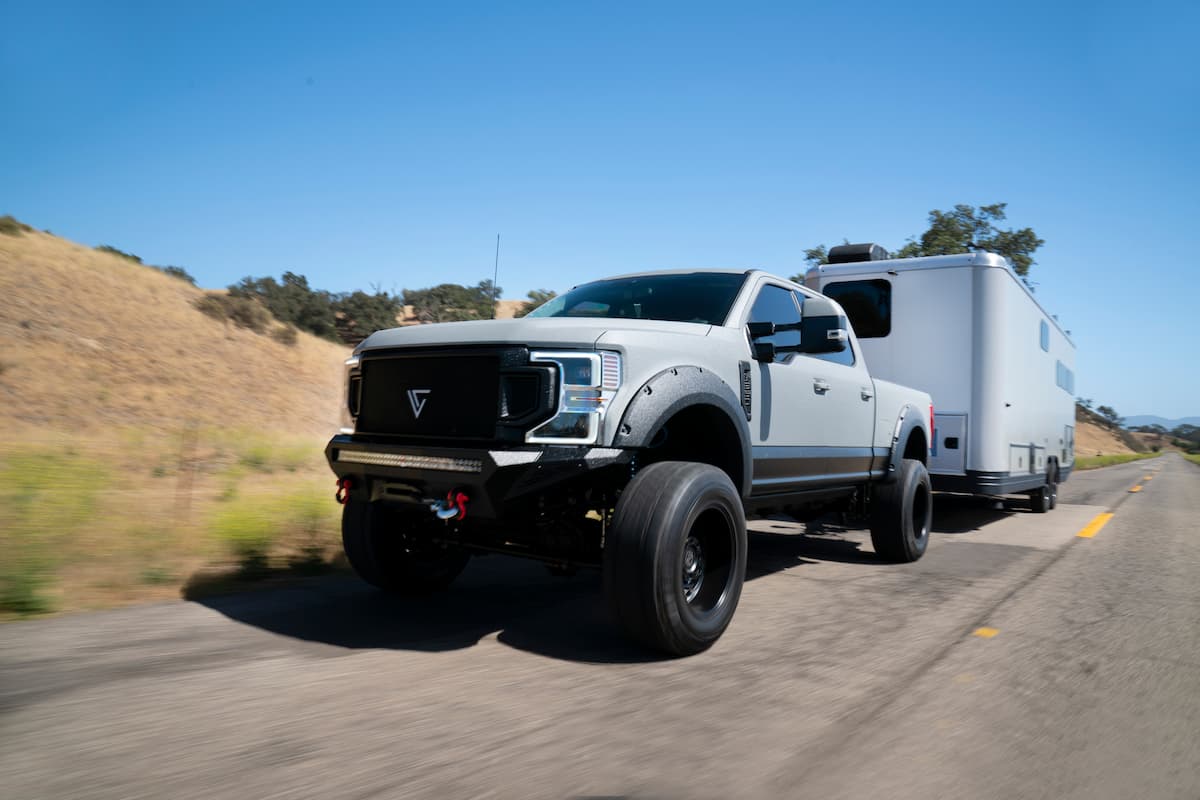
About ten years ago, I left a secure job as an architectural designer, started my own firm and moved into a 1970s aluminum travel trailer. That trailer became the spark for everything that followed, including Living Vehicle and our search for the most luxurious, self-sufficient off-grid home on wheels.
I've lived in a lot of small spaces since then, on land and at sea. A travel trailer behind a capable pickup is still my favorite. Unlike a motorhome, a trailer has no engine of its own, so the truck you pair it with shapes the whole experience. This guide covers what I've learned about choosing that truck.
In this guide:
- Which truck should you start with?
- Which ratings matter for towing?
- Do you need a half-ton, ¾-ton or 1-ton?
- Gas, diesel or electric: which tows best?
- Which cab and bed should you choose?
- Do suspension, wheels and tires matter?
- Can your truck power the trailer at camp?
- What does it take to tow the LV Line?
Which truck should you start with?
A trailer only moves when you travel, but you drive your truck every day. The best tow vehicle is one you're happy to run errands in, park in town and hand to anyone in the family, with or without a trailer behind it.
Modern pickups make that easy. Today's trucks ride and feel like luxury cars inside, with comfortable seats, quiet cabins and good technology, and they still carry five or six people, their gear and their pets. Choose the truck you'll enjoy every day, then confirm it has the ratings your trailer needs.
Which ratings matter for towing?
Every truck is different. Two trucks with the same badge can have very different ratings depending on engine, axle ratio, cab, bed and options, so always check the sticker or the manufacturer's towing guide for the exact truck you're considering.
- Trailer GVWR. The most the trailer can weigh fully loaded. Size your truck to this number. Dry weight is lower, but you'll never tow it empty once water, gear and supplies are on board.
- Towing capacity. How much the truck can pull. It should be at or above the trailer's GVWR, ideally with some margin.
- Tongue weight. The weight the trailer's coupler puts on the hitch, typically 10 to 15 percent of the loaded trailer. Your hitch and the truck's tongue-weight rating both need to cover it.
- Payload. Everything the truck carries: passengers, cargo, the bed and the tongue weight. This is the rating people most often run out of first.
Here's how it adds up. Take a trailer that weighs 11,000 lb loaded. At 10 to 15 percent, that's roughly 1,100 to 1,650 lb on the hitch. Add a driver and three passengers at about 600 lb and a few hundred pounds of gear, and you can be past 2,500 lb of payload before you leave the driveway. Run the numbers for your own truck and trailer, and leave yourself room.
Do you need a half-ton, ¾-ton or 1-ton?
The "ton" names are old shorthand, but they're still the easiest way to sort trucks:
- Half-ton (F-150, Ram 1500, Silverado 1500, Sierra 1500, Tundra and similar). The best-equipped versions are rated to tow well over 10,000 lb, but payload is usually the limit. They suit lighter trailers when properly equipped.
- ¾-ton (F-250, Ram 2500, Silverado 2500HD, Sierra 2500HD). Built for towing and hauling, with more payload, stronger axles and brakes, and a stiffer frame. For most larger travel trailers, a ¾-ton is the sweet spot.
- 1-ton (F-350, Ram 3500, Silverado 3500HD, Sierra 3500HD). The same engines as a ¾-ton in most cases, with suspension built to carry more. Choose one for the heaviest trailers, or if you'll carry heavy loads in the bed while towing.
Dual rear wheels add even more payload, but most bumper-pull owners don't need them. They make the most sense if you also haul a fifth wheel or gooseneck, or carry something heavy like motorcycles in the bed.
Gas, diesel or electric: which tows best?
Diesel is still the favorite for heavy, long-distance towing: strong low-end torque, durable drivetrains and good fuel economy under load. If you tow a large trailer often, especially over mountain passes, a diesel is hard to beat.
Gas trucks cost less up front and are simpler to maintain. Today's big gas engines tow very well, and for lighter trailers or occasional trips they're an excellent choice. Compare the actual ratings for each truck.
Electric trucks are now real tow vehicles. They deliver instant torque, smooth power and a quiet cabin. The trade-off is range: pulling a large trailer typically cuts an EV's range by about half, so plan charging stops closer together and look for pull-through chargers. Properly equipped, the leading electric trucks are rated to tow lighter travel trailers. Our towing guide covers what that means for the LV Line.
Which cab and bed should you choose?
Cab. A crew cab gives you four full doors and a real back seat. At 6'5", I fit comfortably in the back of most full-size crew cabs. If you have a larger family or spend long days on the road, the largest cab available is worth it.
Bed. Short beds (about 5½ to 6½ feet) are easier to park and turn, which matters in a daily driver. Long beds (8 feet) carry more. Towing capacity is usually similar either way, so choose for how you'll use the truck on the days you aren't towing.
Do suspension, wheels and tires matter?
Heavy-duty trucks ride firmly because they're built to carry weight. Quality aftermarket shocks and suspension upgrades can improve the ride a lot, as long as they keep the factory towing and payload ratings.
The same goes for wheels and tires. Larger tires on a modest wheel soften small bumps and expansion joints and help with traction in rain, snow and dirt. Always choose a load rating that matches or exceeds the factory tires; your setup is only as strong as its weakest part.
A good weight-distributing hitch with sway control makes any large travel trailer tow better. Have it set up for your truck and trailer, and check it again after you load for a trip.
Can your truck power the trailer at camp?
A truck's 7-pin connector runs the trailer's lights and brakes, but it supplies very little charging power. Every LV Line model makes its own power with solar, a large battery and a backup generator, so it stays powered at camp whatever you tow it with. Your truck only has to cover the drive.
What does it take to tow the LV Line?
The LV Line is designed to tow behind the trucks people actually drive. The lightest model is within reach of select half-ton and electric trucks when properly equipped, and we recommend a ¾-ton for the most margin. The larger models call for a ¾-ton or 1-ton truck. Before we built it, we also put the LV Line through a full airflow study to understand how it moves through the air.
Read the LV Line towing guide → · See the aerodynamic study →
Final thoughts
Pickups have been part of my life since college, from construction work and mountain dirt roads to years of pulling vintage aluminum trailers across the country. It's remarkable how capable, comfortable and varied today's trucks have become, whether they run on gas, diesel or electricity. Start with the truck you'll love driving every day, match its ratings to your loaded trailer, and leave yourself a margin. The rest is the fun part.
Always confirm your truck's ratings with its manufacturer.